History and origin of carrot cake
Carrot cake is a classic dessert with its roots in medieval Europe, when carrots were used as a sweetener due to the scarcity of sugar. This recipe evolved over time and gained popularity especially in the United Kingdom during World War II, when sweet ingredients were hard to come by. In Latin America, carrot cake is known in several countries, although it may have different names or variations in its preparation. For example, in Mexico and Costa Rica it is simply called "carrot cake", while in other countries such as Argentina and Chile, the cake is usually accompanied by specific creams or fillings such as cream cheese.
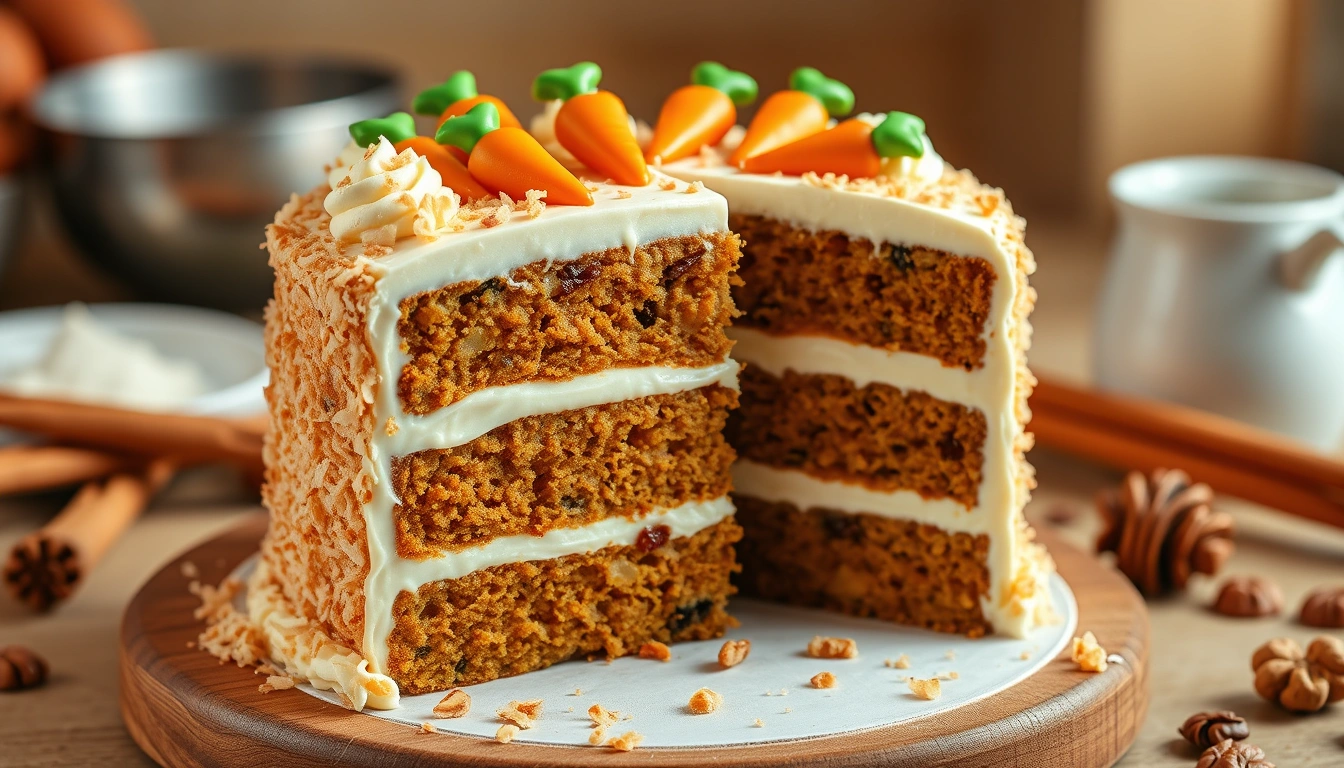
This cake is appreciated for its moist texture and balanced flavor, which combines the natural sweetness of carrots with spices and nuts. In addition, its cream cheese frosting gives it a creamy touch that makes it irresistible for celebrations and special occasions.
How to prepare Commissary Store carrot cake
Ingredients: Sugar, flour, salt, whipping cream, unsalted butter, pecans, vanilla, corn oil, cinnamon, baking powder, eggs, carrots, raisins, cream cheese frosting, cream cheese, powdered sugar, vanilla extract, coconut.
Preparation steps:
In a heavy saucepan, mix the flour, sugar and salt well.
Gradually add the cream while stirring.
Add the butter.
Cook and stir the mixture over low heat until the butter has melted, then simmer for 20-30 minutes until it turns a golden color, stirring occasionally.
Let cool until warm.
Add the nuts and vanilla.
Let cool and refrigerate, preferably overnight.
If it is too thick to spread, bring to room temperature before using.
Preheat the oven to 350 °F.
Have a greased and floured 10" tube cake pan ready.
In a large bowl, beat together the corn oil and sugar.
Sift the flour, cinnamon, baking powder, baking soda and salt.
Sift half of the dry ingredients over the sugar and oil mixture and mix.
Alternately, sift the rest of the dry ingredients while adding the eggs, one by one.
Combine well.
Add the carrots, raisins and pecans.
Pour into the prepared pan and bake for 70 minutes.
Cool the cake upright on a cooling rack; if you are not going to use the cake that day, it can be removed from the pan, wrapped in plastic and stored at room temperature.
For the cream cheese filling, beat the butter well.
Add the cream cheese and beat until combined.
Sift the sugar and add the vanilla.
If it is too soft to spread, chill slightly.
Refrigerate if not using immediately, but bring to room temperature before spreading.
For assembly, preheat the oven to 300 °F.
Spread the coconut on a baking sheet and bake for 10-15 minutes until lightly colored.
Stir the coconut occasionally while baking to brown evenly, and let cool completely.
Have the filling and frosting at a spreadable consistency.
Remove the cake from its pan and turn it over onto a serving plate.
With a long serving knife, carefully divide the cake into three horizontal layers.
Spread the filling between the layers.
Spread the frosting on the top and sides.
Press the coconut onto the sides of the cake.
If desired, reserve 1/2 cup of the frosting and tint 1/2 with green food coloring and 1/2 with orange, and decorate the top to form small carrots.